Putting Education Back in the Hands of Parents and Local Communities
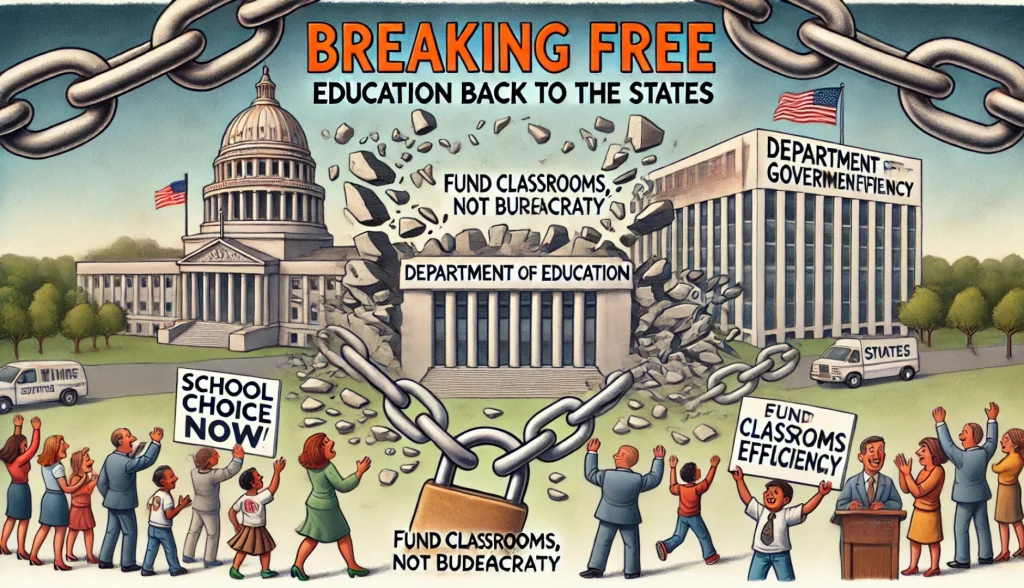
For decades, Washington bureaucrats have dictated how American children are educated, stripping local communities of control and burdening schools with top-down mandates that stifle innovation. The U.S. Department of Education, created in 1979, has done little to improve educational outcomes but has become a massive administrative force siphoning billions of dollars away from classrooms and into bureaucratic overhead.
Now, with efforts underway to shrink and ultimately dismantle this agency, we have a chance to restore power to states, parents, and local leaders who know what’s best for their schools. This is about more than just reducing government—it’s about returning education to the people it truly serves: families and students.
Why the Department of Education Has Failed America
Federal Overreach Has Made Schools Worse, Not Better
The Department of Education was supposed to improve learning outcomes and ensure equal access to quality education. Instead, it has become an unaccountable bureaucracy that forces schools to comply with one-size-fits-all mandates, regardless of what works for local communities.
The reality is simple: education policies that work in rural Idaho won’t be the same as those needed in downtown Chicago—yet Washington continues to push rigid policies that limit flexibility, creativity, and local problem-solving.
More Bureaucracy, Less Education
Every year, billions of taxpayer dollars flow into the Department of Education—but how much of it actually reaches students?
- Excessive administrative costs swallow funding that should be spent in classrooms.
- Red tape and regulations make it harder for schools to adopt better practices.
- Politically motivated policies prioritize ideology over learning.
By cutting federal control, we can redirect those resources where they belong: into schools, teachers, and real education—not government overhead.
Expanding School Choice: The Path to Better Outcomes
Eliminating federal overreach isn’t just about shrinking bureaucracy—it’s about creating opportunities.
School choice is the key to educational excellence. Parents should have the right to decide where and how their children are educated, whether that means public schools, charter schools, private schools, homeschooling, or vocational training programs.
The Proof is in the Results
States and cities that have embraced school choice have seen dramatic improvements in student success.
- Charter schools in New Orleans have outperformed traditional public schools since the city moved to a choice-based system.
- Florida’s tax credit scholarship program has helped thousands of low-income families access better education.
- Arizona’s universal school choice program has given families control over their child’s education, allowing them to use public funds for the schools that work best for them.
If school choice works in these places, it can work nationwide.
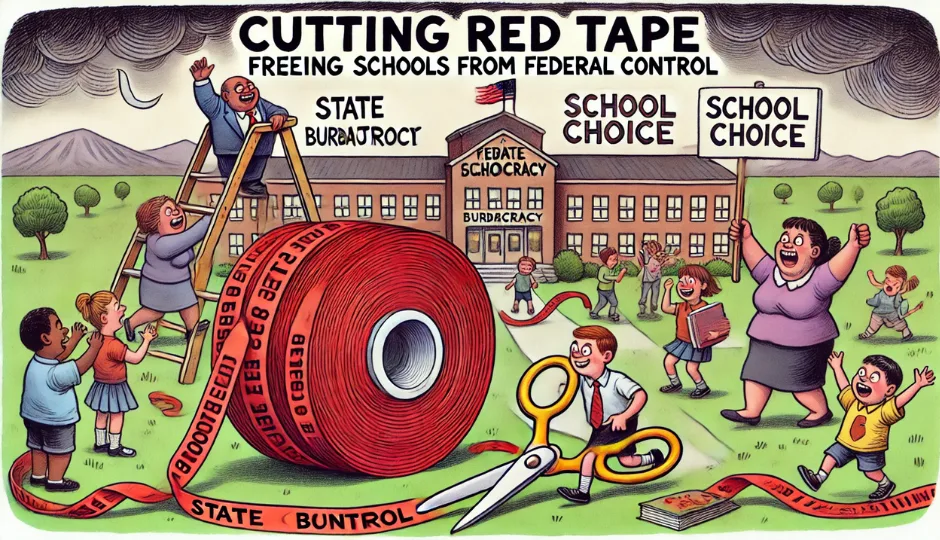
Cutting Red Tape to Free Schools from Federal Control
The movement to dismantle the Department of Education is about more than just efficiency—it’s about freedom.
- Freedom from bloated bureaucracy that slows down progress.
- Freedom from union-backed mandates that put politics ahead of students.
- Freedom for states and local communities to implement what works best for their schools.
Every dollar spent on compliance and federal paperwork is a dollar that doesn’t go toward books, teachers, or improving student achievement. By cutting red tape and ending unnecessary federal programs, we can focus on real solutions instead of propping up a broken system.
Addressing the Critics: Protecting Civil Rights Without Federal Overreach
Opponents argue that dismantling the Department of Education would weaken civil rights protections. This is a false narrative.
The federal government has existing mechanisms—like the Department of Justice—to ensure that students’ rights are upheld without requiring a massive education bureaucracy. Civil rights enforcement can and should continue, but it does not require Washington to control education policy.
The best way to address local issues is through local leadership—not through unelected bureaucrats thousands of miles away.
What Comes Next? A Vision for the Future
Eliminating the Department of Education is not an end—it’s a beginning.
A new era of education freedom would give states the ability to:
- Experiment with tech-driven learning to customize education for each student.
- Expand vocational training programs that prepare students for real-world jobs instead of pushing college as the only path.
- Encourage flexible learning models that allow for hybrid and homeschool options tailored to individual needs.
When Washington steps back, parents and communities step up.
The Time for Change is Now
For too long, America’s education system has served bureaucrats, unions, and political agendas—not students.
Shrinking the Department of Education is about one thing: returning education to the people.
The choice is clear—do we continue to prop up an outdated, ineffective bureaucracy, or do we embrace reform that empowers parents and transforms education?
We choose reform. We choose students. We choose education freedom.